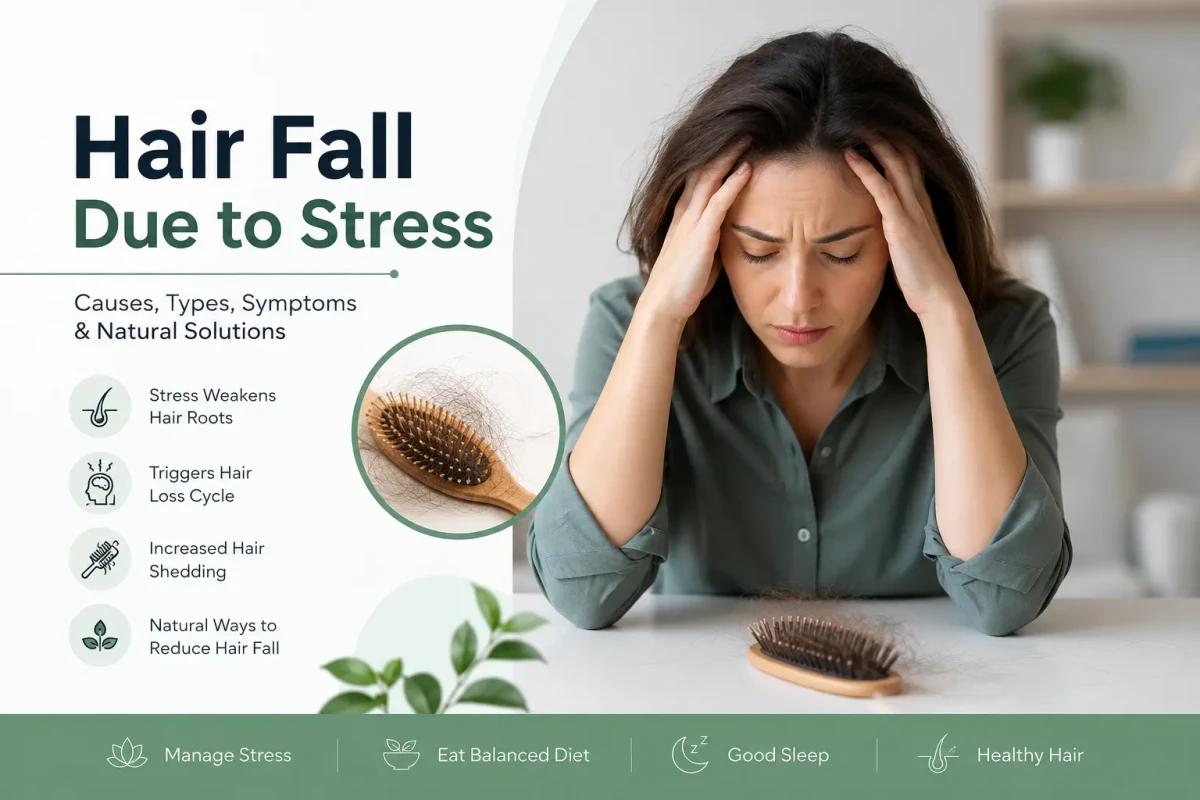
Hair Fall Due to Stress: Causes, Symptoms, and Effective Solutions
Why is your hair falling more than usual? Have you ever noticed sudden hair shedding during stressful periods in your life? Tight deadlines, emotional strain, lack of sleep, and suddenly your hairbrush is full. You’re not imagining it. Stress-induced hair fall is real, common, and often misunderstood. The frustrating part? Most people treat their hair externally without addressing the cause. If you don’t address the stress, no oil, shampoo, or supplement can fix the issue in the long term. Hair fall due to stress is one of the most common issues that most people around the world face nowadays.
What is Stress Induced Hair fall?
Hair fall caused or triggered due to stress, be it physical, emotional, or psychological, is stress-induced hairfall. It is medically linked to conditions like telogen effluvium, which is the most common, alopecia areata, trichotillomania, or compulsive hair-pulling. Stress disrupts the natural hair growth cycle. Understanding hairfall due to stress is the first step toward controlling it.
How Does Hair Growth Work?
Hair grows in cycles: Anagen is the growth phase, Catagen is the transition phase, and telogen is the resting phase. Under normal conditions, most hair remains in the growth phase only. But due to stress, the hair shifts prematurely into the resting phase, and this leads to delayed shedding. This is why people experience hairfall due to stress 2-3 months after the stressful event.
Types of Hair Fall due to Stress
Telogen Effluvium:
It is the most common form of hair loss. It is caused by emotional trauma, illness, and sudden lifestyle changes and results in diffuse thinning and heavy shedding.
It is an autoimmune condition triggered by stress and is a more intense form of hair loss. It leads to patchy hair loss and requires medical attention.
Trichotillomania:
It is a behavioral condition linked to stress. People pull their own hair subconsciously, though it is different, but still categorized under stress-induced hair fall.
Major Causes of Hair Fall Due to Stress
Work pressure and burnout.
Emotional trauma and grief.
Anxiety and overthinking.
Sleep deprivation.
Hormonal imbalance triggered by stress.
Poor lifestyle habits.
Symptoms of Stress Induced Hair Fall
Sudden increase in hair shedding.
Noticeable thinning of hair.
Hair fall while washing or combing.
Reduced hair volume.
Weak, lifeless strands.
Why Does Hair Fall Due to Stress Get Worse Over Time?
Stress increases the cortisol levels, and high cortisol weakens the hair follicles and disrupts the hair growth cycle. Continuous stress eventually leads to continuous hair fall, and this creates a cycle,more stress leading to more hair fall. To control hair fall, you need to manage your stress first because without stress control, hair fall will not stop. To manage this, you need to practice meditation, yoga, and deep breathing. Secondly, improve your sleep, as poor sleep directly increases hair fall. So, aim for 7-8 hours of sleep daily. Thirdly, a balanced diet as nutritional deficiencies worsen hair fall, so try to include protein, iron, and healthy fats in your meals. Fourth is scalp care, which helps to support recovery from hair fall due to stress, use mild products, and avoid over-styling. And the most important is exercise, it reduces the stress hormones and improves the blood flow in the body, which helps in supporting recovery from hair fall.
Role of Homeopathy
Homeopathy focuses on treating the root cause of hair fall and helps in reducing mental stress and balancing the internal system. Some common homeopathic remedies for hair fall are Natrum Mur, which helps in emotional stress, Kali Phos, used for mental exhaustion, and Phosphorus, used for weakness-related hair fall.
The recovery timeline in homeopathy varies according to the severity of the patient; however, normally, the hairfall starts reducing in 6-8 weeks if stress is managed. The regrowth begins in 3-4 months, and you can see visible recovery in 6-9 months.
When should you consult a doctor? If the hair fall continues beyond 3 months, when bald patches start appearing, and when there are no signs of regrowth. Ignoring hair fall can lead to long-term damage, which sometimes can be irreversible.
Tips to Reduce Hair Fall
Start your morning with meditation and a healthy breakfast.
During the day, stay hydrated and manage workload.
Exercise in the evening.
Get proper sleep at night.
Addressing Myths About Hair Fall
It will stop automatically: In some cases, it can, but not if the stress continues.
Oil alone cannot fix hair fall: It is completely false, as the main cause is hair fall due to stress, which is internal, and oil alone cannot fix it unless you address the actual cause.
Only physical health matters: Mental health is also equally important, as both physical and mental health reflect in your overall body, internal and external.
Hair fall due to stress is one of the most common yet ignored causes of hair loss. It is not just a hair problem but also a big lifestyle issue. The solution lies in stress management, proper nutrition, and consistent care, and if you fix the cause of the problem, the hair fall can be completely reversed.
Comments (0)
Loading comments...